
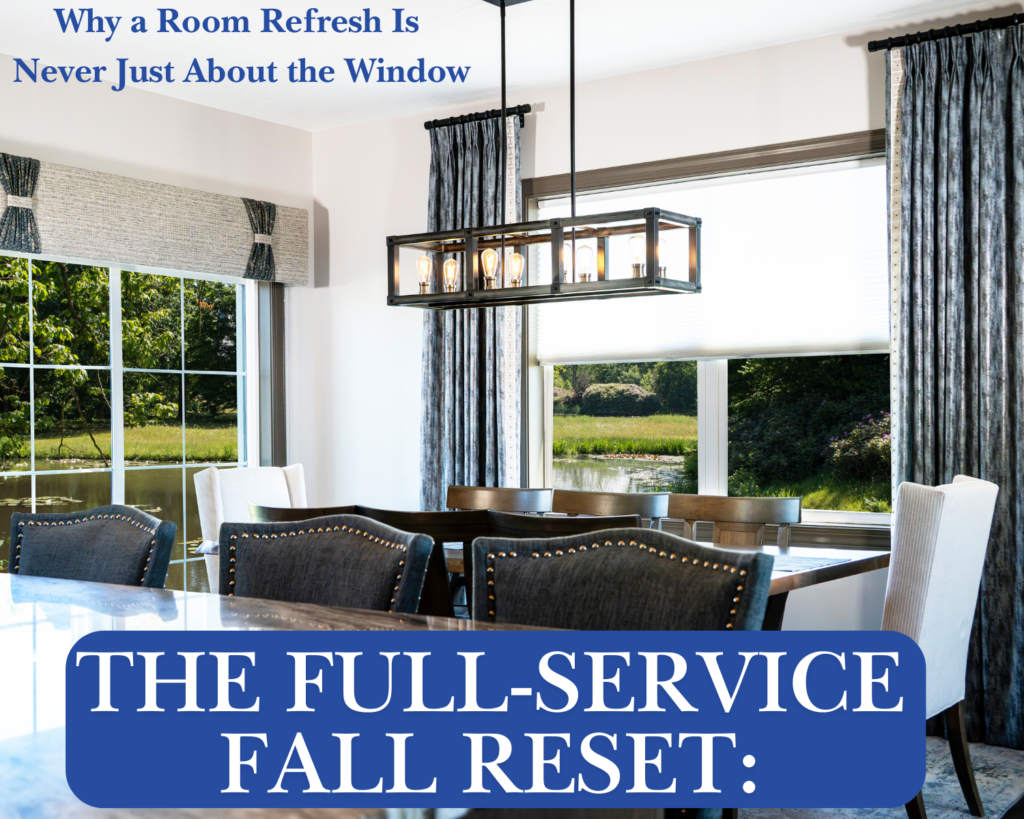
Every fall, we get some version of the same phone call. Someone wants new curtains for the living room, or shades for a bedroom that gets too much morning sun. By the end of the consultation, though, the conversation has almost always drifted somewhere bigger — the rug that’s looked tired since 2019, the wall that’s needed something for two years, the furniture arrangement nobody’s happy with. That’s not a sales pitch. It’s just what happens when you actually sit down and look at a room as a whole instead of one window at a time.
Window treatments are still where most of our conversations start, and there’s a good reason for that. Windows are the largest, most visually dominant feature in most rooms, and they’re also the piece of the room that’s hardest to get right without help — the wrong fabric weight, the wrong mount, the wrong length, and a beautiful window becomes the thing that makes a room look unfinished instead of the thing that pulls it together. But a window treatment doesn’t exist in isolation. It exists next to a rug, above a piece of furniture, across from a wall that either supports it or fights with it.
Fall is a natural moment to notice this. The light changes — lower angle, warmer color temperature, shorter days — and rooms that felt fine all summer suddenly feel a little off. A living room that was bright and breezy in July can feel dim and heavy by late September if the drapery, rug, and wall color aren’t working together to manage that shift. This is usually when we hear, “I don’t know what’s wrong, it just doesn’t feel right in here anymore.” Often, nothing is actually wrong. The room simply hasn’t been updated to match the season, and one element — usually the window — has been carrying the whole room by itself for too long.
Take a kid’s or teen’s bedroom, which is a room we’re thinking about a lot this time of year as school schedules return. The obvious fix for a room that’s too bright too early is a room-darkening shade or a blackout drapery liner, and that alone solves the sleep problem. But look at the room as a whole and you’ll often find a rug that’s seen three summers of bare feet and backpacks, walls that have been the same color since the crib came out, and furniture that no longer fits how the room is actually used. Treating just the window fixes the light. Treating the room fixes how it feels to be in it.
The entryway is an even clearer case. It’s arguably the hardest-working room in the house and the one most people design last, if at all. A window treatment there is almost always about glare and privacy — controlling the view in without losing the view out. But the entryway lives or dies on the floor and the walls around it: a rug durable enough to handle mud and backpacks, and a wallpaper or paint choice that can visually absorb daily wear instead of showing every scuff. None of these decisions happen in a vacuum. They inform each other.
The home office is the newest addition to this list, and one we get more questions about every year. As routines shift back toward in-person work and school, glare on a screen becomes a daily annoyance instead of an occasional one. Light-filtering shades are the obvious fix, but the fabric choice also affects the acoustics of a room that doubles as a video-call backdrop, and the wall behind the desk is now something clients and coworkers see on every call. A window treatment decision in a home office is really an “on-camera room” decision.
This is the actual argument for working with a full-service studio instead of piecing a room together vendor by vendor. It’s not about upselling more products. It’s about making decisions in the right order, with someone who can see how the fabric, the rug, the wallpaper, and the furniture are going to sit next to each other before you’ve committed to any one of them. Choosing a rug after the drapery is already hung means matching to what exists. Choosing them together means everything gets to be intentional.
If a full room refresh feels like too many decisions at once, here’s the shortcut we give clients: start with the window. Decide how much light and privacy you actually want — blackout, room-darkening, or filtering — and what fabric weight and color feel right in that light. Every other decision in the room, from rug tone to wall treatment, gets easier once that one is settled, because it becomes the anchor everything else responds to.
This is also where our vendor relationships with partners like Kravet, Fabricut, and Carole earn their keep — not because any one name matters more than the room itself, but because having that range means we’re not limited to whatever a single fabric line happens to offer that season. We can match a mood, a budget, and a durability requirement instead of working backward from a limited catalog.
If motorization is part of your plan, it’s worth noting that our free PowerView® Motorization offer on Silhouette® and Pirouette® shades — a $250 savings per shade — runs through September 30, which lines up well with a fall refresh timeline if you’re planning to start soon.
None of this requires doing an entire home at once, or even an entire room. It just requires looking at the window as the start of a conversation about the room, not the whole conversation. If your space has felt a little off since summer ended, that’s usually the sign it’s time to look at it as a whole — starting whenever you’re ready.